Projects
Selected academic, professional, and certification-based projects demonstrating applied chemical engineering fundamentals, data analysis, and communication skills.Â
Led the development of an excess emissions report following a client incident regulated by the Iowa Department of Natural Resources (IDNR).Â
Investigated the incident to understand process operations, failure conditions, and environmental implications
Built a structured Excel workbook to organize venting timelines and fermenter operating parameters
Coordinated directly with the client to obtain missing operational data and confirm corrective actions
Performed emissions calculations using process data and applicable regulatory limits
Cross-referenced the facility’s Title V operating permit and relevant IDNR emission standards to identify compliance deviations
Determined that approximately 80 lb of excess emissions were released, exceeding permitted limits
Compiled calculations, assumptions, client inputs, and preventive measures into a clear report
Excel (data organization and calculations), Title V permits, IDNR emission standards, engineering calculations
Delivered a complete excess emissions report within the regulatory deadline
Met IDNR compliance and documentation standards
Provided the client with a transparent, data-backed account of the incident and recommended prevention strategies
Strengthened skills in regulatory compliance analysis, process data interpretation, Excel-based emissions modeling, and professional technical reporting
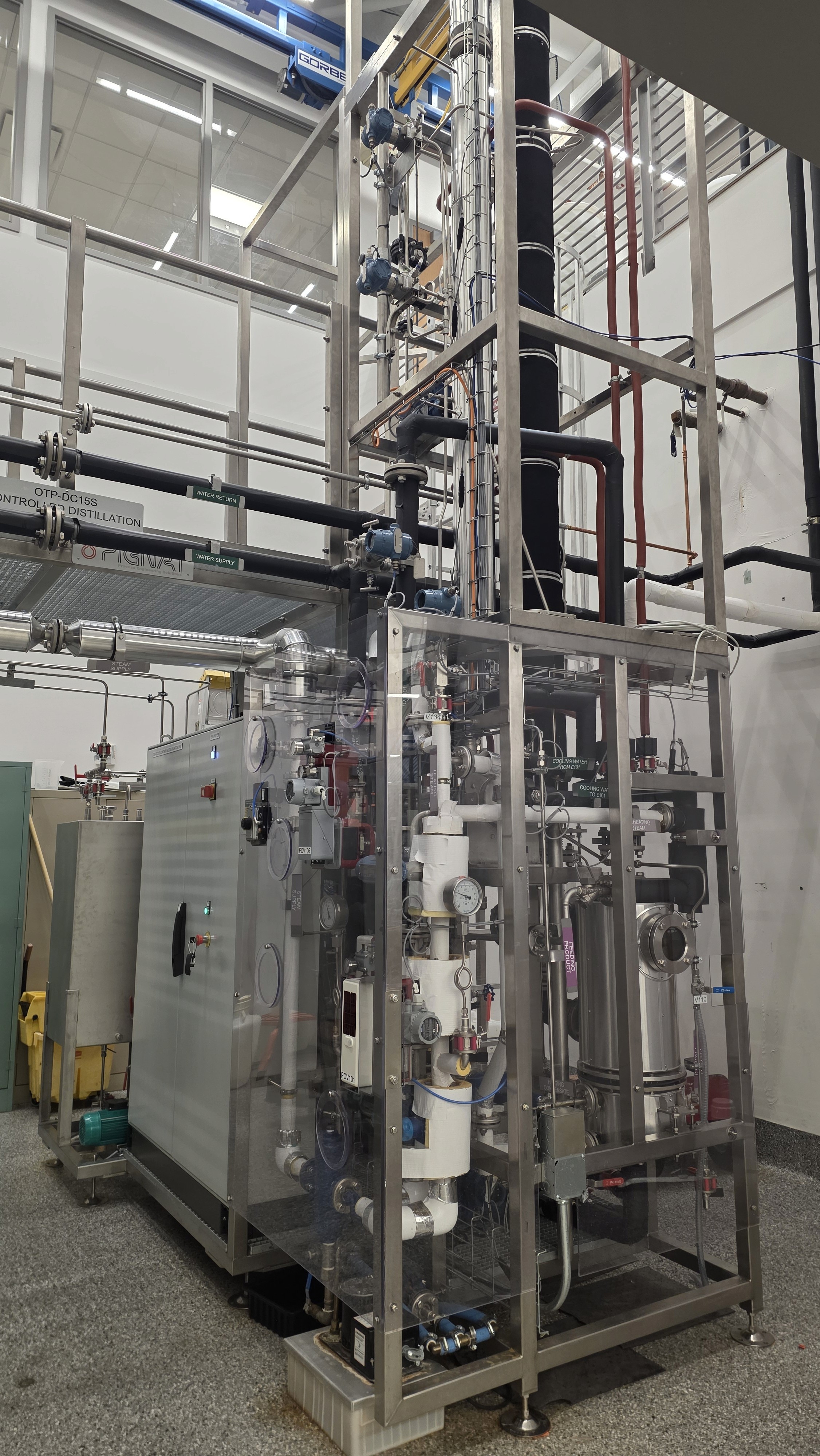
Multi-week unit operations lab focused on analyzing a packed distillation column separating a binary mixture under varying operating conditions as part of a team.
Collected experimental data across multiple steady-state operating conditions
Performed component-level mass balances and energy balances to validate data consistency
Compared experimental trends (temperature and composition profiles) to Aspen Plus simulation outputs
Evaluated the directional impact of changes in reflux ratio and feed conditions on separation performance
Aspen Plus, Excel, unit operations principles and heuristics
Identified systematic deviations between experimental and theoretical behavior
Demonstrated ability to work with imperfect, real-world data
Supported data-backed conclusions through reconciliation and trend analysis
Communicated results in an oral presentation and represented my team
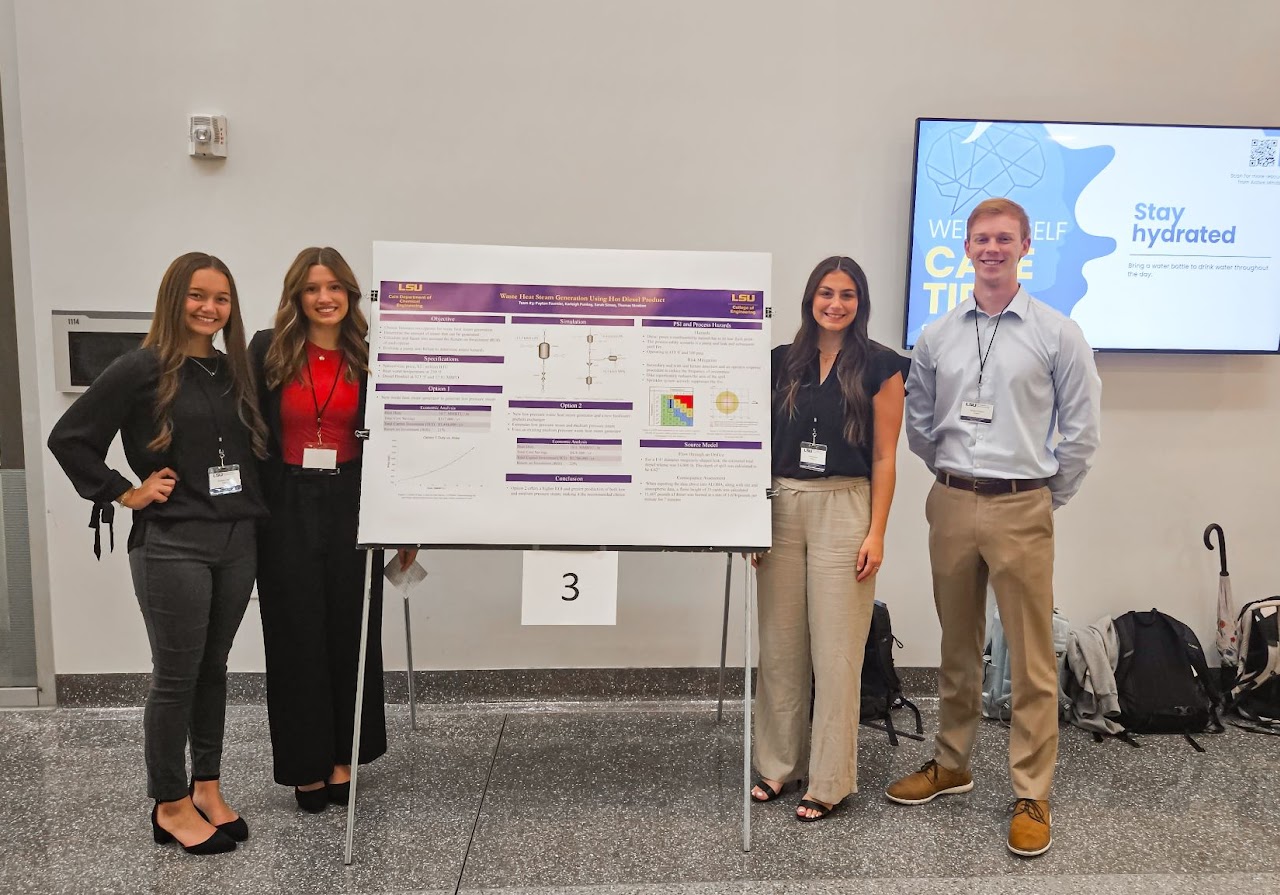
Process design project focused on assessing the technical feasibility of recovering excess thermal energy from a process stream.
Assessed available waste heat potential using energy balances
Evaluated design constraints, including safety and operational considerations
Performed an economic analysis of the design using Aspen Plus
Compared alternative design approaches
Participated in team-based decision-making and technical justification
Process design fundamentals, energy balances, Aspen Plus, ALOHA
Developed a technically sound conceptual design
Demonstrated ability to evaluate tradeoffs between efficiency, safety, and complexity
Strengthened collaborative problem-solving and technical communication skills
Presented a formal, oral presentation alongside team members to faculty and industry professionals
Completed a refrigeration system project as part of an engineering measurements laboratory, where my team conducted open and closed loop experiments on a chiller system and then developed a conceptual refrigeration design to meet specified production requirements for a facility located in Gatlinburg, Tennessee.
Ran controlled laboratory experiments on a chiller, collecting temperature and pressure data at key points in the cycle
Applied energy balances and thermodynamic relationships to analyze system behavior
Used experimental results to inform a conceptual vapor-compression refrigeration design
Analyzed theoretical efficiency and heat requirements based on production specifications and site location
Served as the primary presenter for the team, communicating methodology, assumptions, and design rationale
Excel, Powerpoint, thermodynamics, heat and mass transfer fundamentals, experimental lab/measurement techniques
Connected experimental chiller data to theoretical refrigeration cycle performance
Evaluated refrigeration requirements under real-world constraints
Strengthened ability to communicate technical analysis and design concepts clearly to an audience
This project centers on the catalytic conversion of propylene (C3=) into higher-value products, emphasizing process design principles, modeling scenarios, and safety.
Building material balances in Excel using conversion, selectivity, and extent-of-reaction methods
Structuring calculations to define all inlet and outlet stream flowrates at steady state
Validating balance consistency and documenting assumptions clearly
Expanding the design into a full process flow, including downstream separations and supporting unit operations using Aspen PlusÂ
Evaluating design objectives and optimization targets such as yield, efficiency, and feasibility
Incorporating safety, operational, and economic considerations into the final design
Working collaboratively within a team
Preparing a final technical report and presentation delivered to faculty and industry professionals
Aspen Plus, Excel, PowerPoint
In progress. Progressing from material and energy balance development to an early-stage process design model.
Completed multiple applied projects focused on customer discovery and needs analysis
Practiced value-based messaging rather than feature-focused selling
Used Zapier to automate sales workflows and reduce manual steps in outreach processes
Used Microsoft Copilot to assist in building and refining sales pitch presentations
Microsoft Word, PowerPoint, Excel, Copilot, Zapier, Customer Relationship Management Software
Strengthened ability to connect technical solutions to business problems
Built confidence in customer-facing and professional communication
Gained hands-on experience using automation and AI to support sales efficiency
Built nested formulas
Used PivotTables to analyze and summarize large datasets
Structured spreadsheets for clarity, accuracy, and reusability
Microsoft Excel - Office 365
Ability to efficiently analyze and organize data
Improved speed and confidence working with complex spreadsheets
Strong foundation for data-driven engineering and business decisions
Built process flow diagrams using Aspen Plus to represent real chemical systems
Modeled separation processes using the RADFRAC block, including defining feed conditions, stages, reflux specifications, and product streams
Modeled heat transfer operations using the HEATX block to represent heaters, coolers, and heat exchangers
Defined thermodynamic property methods appropriate for process conditions
Interpreted simulation outputs (temperature, flowrate, and composition trends) to evaluate process behavior
Connected simulation results back to material and energy balance fundamentals
Aspen Plus
Strengthened ability to translate real-world unit operations into simulation models
Gained confidence navigating Aspen Plus block logic and specifications
Reinforced understanding of how modeling supports engineering analysis and decision-making